
Commercial Law
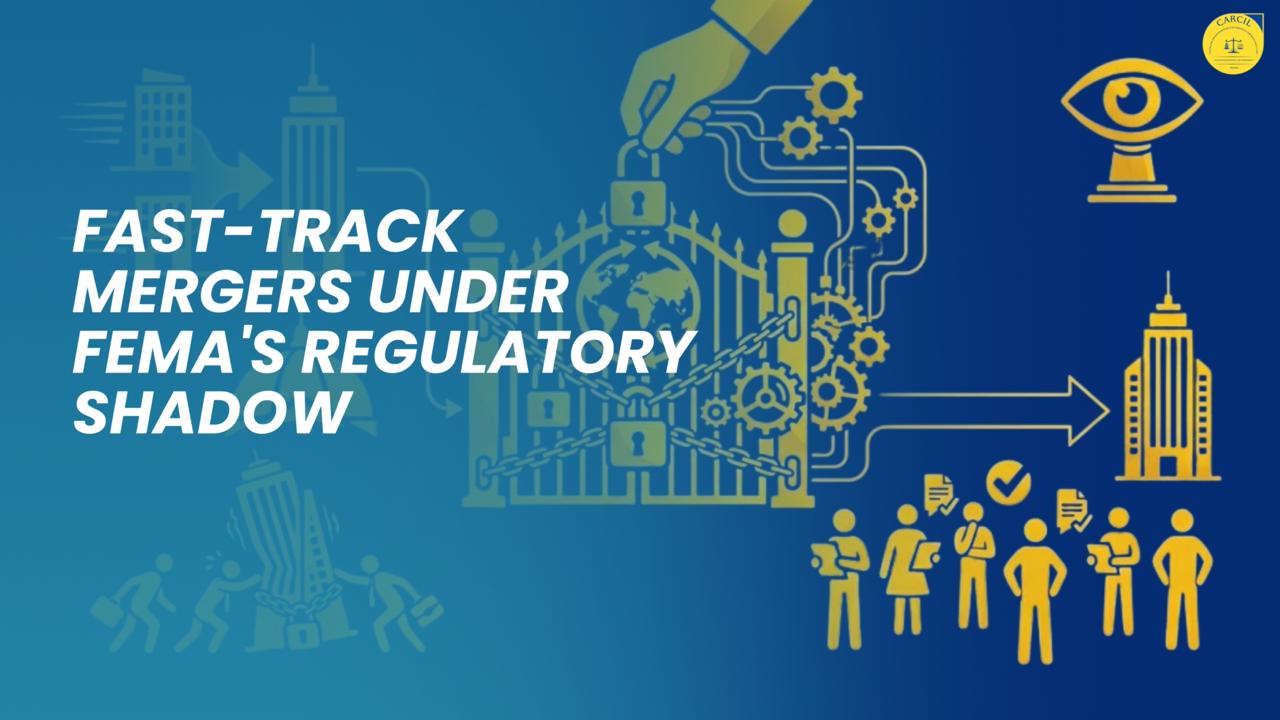
The Intersection of Fast-Track Mergers and Reverse Flipping
The Ministry of Corporate Affairs (MCA) issued notifications regarding the amendments on 4 September 2025 to the Companies (Compromises, Arrangements, and Amalgamations) Rules 2016, in response to the rise in reverse flipping. According to 2022 and 2023, six startups went public every year; 2024 reached a peak with 13 startups, and 18 startups went public in 2025. All of these startups raised around ₹41,000 crore in total, due to reasons like IPO readiness, regulatory assurance, and the availability of sophisticated capital markets in India, reflecting an increase in the matter. These amendments aimed to simplify fast-track mergers under Section 233 of the Companies Act 2013, by expanding the scope to include unlisted companies with borrowing not exceeding ₹200 crore, without any defaults, and with minimal intervention of National Company Law Tribunal (NCLT) and timelines ranging from three to six months.
This also raises an important question: are cross-border flips actually operated within the provisions of Section 233, or does the Foreign Exchange Management Act 1999 (FEMA) remain a dominant gatekeeper by requiring approval from the Reserve Bank of India (RBI)? This analysis holds that FEMA remains a dominant gatekeeper in reverse flipping transactions, despite the fact that the new reforms simplify the process available under the company law. This weakens the intended efficiency of the fast-track mergers as it results in a dual-approval mechanism in such matters.
Reverse Flipping and Cross-Border Mergers
Reverse flipping transactions happen when a company shifts its legal domicile from overseas jurisdictions such as Singapore, the US, or the Cayman Islands, back to India, generally through an inbound merger of the foreign holding company to an Indian entity. Sections 230-232 of the Companies Act 2013, govern mergers in India, which establishes the standard scheme of arrangement process subject to the approval by the National Company Law Tribunal. In contrast, Section 233 provides a fast-track merger route for certain eligible companies, aiming to reduce the intervention and approval of the NCLT. Cross-border mergers are specifically governed by Section 234 of the Companies Act, 2013, read with Rule 25A of the Companies (Compromises, Arrangements, and Amalgamations) Rules 2016, and the Foreign Exchange Management (Cross Border Merger) Regulations 2018 (FEMA Merger Regulations). A structural tension exists between corporate law, which emphasises procedural efficiency, and FEMA, which prioritises capital account regulation, macro-prudential concerns, and deemed RBI approval under Regulation 9(1) for compliant cases.
Section 233 after MCA’s 2025 Amendment
Before the 2025 amendments, the utility of Section 233 was limited, often due to conservative interpretations by regulators and hesitation to apply the fast-track route to complex structures. The process of obtaining NCLT approval for mergers and corporate restructuring could be protracted, often taking nine months to a year or even longer. The 2025 reforms, enacted through the Companies (Compromises, Arrangements and Amalgamations) Amendment Rules 2016, expanded eligibility to include unlisted companies with borrowings ≤ ₹200 crore (no defaults), fellow subsidiaries, and broader intra-group schemes, enabling Regional Director approval instead of full NCLT scrutiny for faster timelines, typically around 3-6 months.
FEMA: The Gatekeeper
RBI exercises its statutory authority in cross-border reverse flipping transactions, given by FEMA Merger Regulations, extensively embodying valuation techniques, implications of capital flows, downstream investment, round-tripping risks, and conformity to market restrictions and pricing protocols. Cross-border transactions falling within the scope of Regulation 9(1) of the FEMA Merger Regulations are considered to have already obtained RBI approval, and therefore, are not required to secure a mandatory approval under Rule 25A of the Companies (Compromises, Arrangements, and Amalgamations) Rules 2016. On the contrary, non-compliant transactions mandatorily require an express approval of the RBI, signifying that in these matters, the RBI effectively acts as the final determining authority and the primary substantive gatekeeper. This renders the procedural streamlining under MCA contingent on FEMA compliance.
Fast-Track Mergers and Cross-Border Reality: Doctrinal Friction
Section 233 of the Companies Act 2013, primarily assists simple and domestic merger transactions that involve only slight risks and steer clear of substantial public interest issues or creditor-related hindrances. On the other hand, reverse-flipping transactions include cross-border elements, are attuned to capital shifts, and are of great importance from a wide economic angle. This mismatch lingers untouched even after the revised 2025 reforms, as they are largely procedural and do not provide directions for cross-border transactional issues. The lack of any established principles in such matters for the uniform use of Section 233 in overseas cases then depends on the regulatory judgments instead of any firm judicial or legal principles. This contradicts the core purpose of the reforms, as apparently, the deals might seem to be suitable for “fast-track” mergers, but would face setbacks in practice due to the obligatory approvals by the RBI under FEMA. This doctrinal friction reveals that even if the 2025 revisions seek to ensure smooth procedural operations, they do not diminish FEMA’s dominance, hindering the swift procedures involved in such matters.
The case of Flipkart in Reverse Flipping Practice
The case of Flipkart is a recent example of reverse flipping transactions. The Singapore-based company of Flipkart merged with its Indian operations due to the domestic IPOs, projected to value around $60–70 billion. Since this merger was categorised as an intra-group merger with minimal stakeholder objections, it was eligible under the amended Section 233. The merger had to be sanctioned by the NCLT because of the complexities involved, which was sanctioned by the Mumbai Bench of the NCLT on 12 December 2025. Since the merger could not live up to the standards prescribed in Regulation 9(1) of the FEMA Merger Regulations, the merger was reviewed extensively by the RBI, which extended the process, covering valuation, share exchange, and the effects of capital movements under its review. The board approval for the merger was obtained in April 2025, but the final approval was received in December 2025, which exceeded the expected three to six months’ timeline, again confirming the preponderant role of FEMA in such regulatory decisions over the company law.
Normative Analysis: Is Section 233 Structurally Ill-Suited for Reverse Flips?
Section 233 and reverse-flipping transactions are mutually distinct from each other. Whereas the former is concerned with procedures regarding minimal risk mergers in India, the latter is basically regulatory and has major macroeconomic implications. This makes the system weak since Section 233 does not provide a mechanism to deal with issues governed by FEMA regulations, except for procedural simplification. This further reveals the likely gap in joint efforts by the institutions, MCA and RBI, since there is no efficient and timely approval mechanism to integrate corporate law procedures with foreign exchange regulations. India can learn from smoother and more integrated practices, such as in Singapore, where the Accounting and Corporate Regulatory Authority (ACRA) and Monetary Authority of Singapore (MAS) work together on these matters to ensure that mergers occur quickly and with more certainty. Even after the 2025 reforms, India has no such integrated and streamlined process in place, forcing reverse-flipping transactions to go through a prolonged dual-staged approval process.
Conclusion
The notifications regarding the amendments in 2025 provide a crucial impetus to achieve a smoother and more efficient procedural regime under Section 233 for foreign reverse-flipping transactions. However, these amendments remain inadequate to bring about any provisions to restrict the RBI’s regulatory discretion, which the RBI exercises through FEMA. Therefore, FEMA continues to take precedence over the above-mentioned company law procedures, where the RBI’s approval is the substantive gatekeeper and, in effect, sidelines the provisions available under Section 233.
There is an immediate need to fill the gap between the MCA and the RBI through strict timelines for approvals in cross-border cases and clear directives to enable Section 233 to operate effectively in cross-border cases. In conclusion, these mergers may move ahead quickly owing to the streamlined procedures, but FEMA and other foreign exchange regulations will continue to slow down their pace until there is a proper coordination mechanism between the MCA and the RBI.

Thank you for sharing your feedback.
Our team will get back to you at the earliest