
Commercial Law
INTRODUCTION
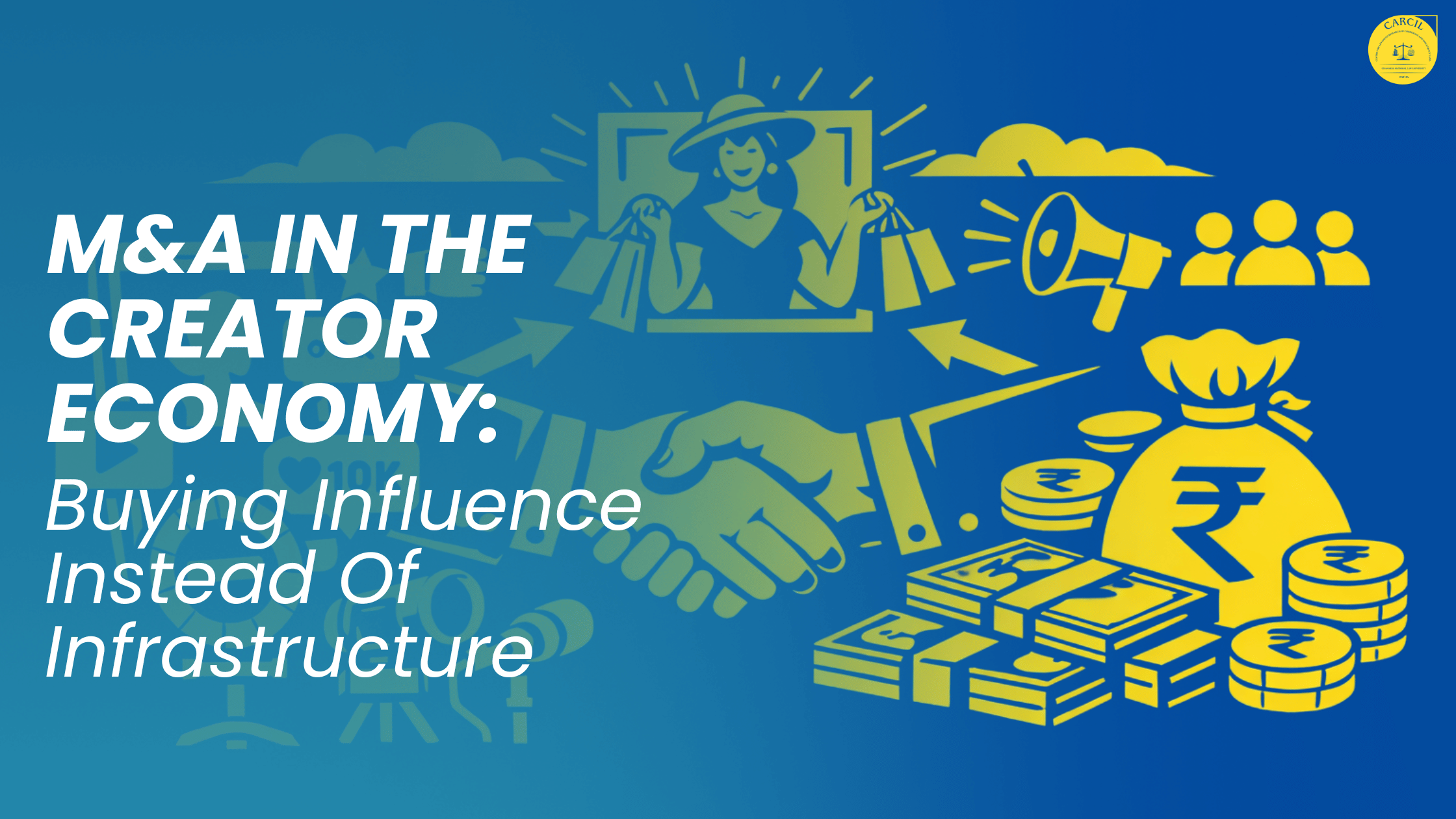
The creator economy, which is centred on individual content creators, influencers, and digital entrepreneurs, has brought about a shift in the manner in which value is created and monetized in the current market scenario. As a result, attention and audience trust have become the new currency. The value of the creator economy, as estimated by Goldman Sachs, is projected to reach $480 billion by 2027. The Merger and Acquisition (“M&A”) activity in this sector has recorded a significant 73% rise on a year-over-year basis over the first half of 2025, as private equity players and major media houses merge and acquire new entrants focused on the creator economy.
Building on the momentum, a central question arises regarding how valuation and liability should be determined, where the distinction between a creator’s personal brand and a company’s goodwill is blurred. The blog examines how traditional M&A frameworks fare in this new era of creator-driven businesses, where personal influence is the essential asset for business. It analyzes the legal uncertainties involved in personality-based intangible assets, specifically goodwill, including ownership, transfer, and valuation. In the end, it offers a practical way to integrate the M&A framework in India, aiming to achieve parity between legal certainty and the dynamics of personal influence and digital goodwill in the creator economy.
The New Face of Goodwill
Conventional corporate goodwill is established from consistent performance, customer trust, and brand recognition developed through an organization’s operations. It is intangible and transferable through valuation, sale, or fusion. On the contrary, a creator’s goodwill is penetratingly personal established in authenticity, individual expression, and emotional significance with their audience. The primary asset becomes audience loyalty. Stepping back of influencer can dodge the acquired goodwill overnight.
Here, the ‘brand’ often is the person. A creator’s market value depends on their identity, voice, and engagement with followers. This has been a gradual movement away from company-based goodwill to personality-based goodwill, where the commercial worth of a venture is tied to its founder’s digital presence and public insight. Unlike earlier businesses that could survive leadership changes, creator-driven ventures face the constant risk of value destruction if the creator decides to withdraw or lose their relevance.
Legal and Commercial Complexities
The challenges surrounding creator-led acquisitions are multifaceted. Primarily, under the current framework of M&A, goodwill is recognized as a transferable commercial right linked with the continuation of business. Under Indian Accounting Standard (Ind AS) 38, goodwill is recognised as an intangible measurable asset. However, in creator economy, the acquirer along with purchasing a company also purchases the persona driving its market worth. Goodwill thus becomes inseparable from the creator’s identity. Assigning an independent monetary value or treating it as a company-owned asset for the purposes of combination becomes difficult.
It also challenges the established principles of ownership, valuation and transferability under Indian company law. In the Good Glamm–POPxo deal, the valuation was largely determined by digital reach and personality-led content, raising concerns about how much goodwill truly belonged to the enterprise and its creators.
Secondly, deal involving a creator’s name, likeness, or endorsement rights fall under personality or publicity rights. These are governed by privacy and intellectual property frameworks. Courts have prohibited exploitation of such rights without consent. It creates a dilemma where acquirer may purchase the business, but unless the creator contracts to license the commercial use of their identity, the goodwill attached to that persona does not legally pass to the acquirer. Besides that, Section 27 of the Indian Contract Act, 1872, provides a restraint on trade, making clauses unenforceable if it is perpetual or overly restrictive. Accordingly, the acquirer’s rights remain conditional on the creator’s continued participation, exposing the deal to reputational and financial risk.
Thirdly, creator-driven enterprise involves registered trademark involving creator’s name or likeliness. Section 37 of the Trademarks Act, 1999 allows assignment and transmission of trademarks. Nonetheless, the transfers mentioned in Sections 40-42 are those that would deceive the public or create confusion regarding the brand’s identity or continuity. In case the creator steps back from the company after the acquisition, they still cannot be a part of the brand with their name which would encroach upon their rights under these provisions.
Additionally, the commercialization of the brand comes with complexities. Traditional transactions are based on point-to-point valuations, whereas in this case, the value is established through various metrics, such as the number of people interacting with the brand, the loyalty of followers, and their perception of the brand. The metrics used for the latter do not correspond to any standard assessments covered by the existing financial regulations. Skilful auditors and due diligence practitioners are obligated to make judgments on the evolving digital metrics that may not pass the objectivity test, according to the Institute of Chartered Accountants of India (ICAI) guidelines, thus making the risk assessment very much dependent on these metrics.
Furthermore, the creator’s activities that result in contingent liabilities, such as defamation lawsuits, breaches of sponsorship agreements, or online controversies, may not be reflected in the financial statements but can significantly influence the post-acquisition value. The absence of statutory regulations on treatment of risks associated with the brand’s reputation continues to cast dounts among buyers and investors. For example, the talks between MrBeast and Night Media regarding the splitting of equity were said to have dragged on due to differing views on the valuation of MrBeast’s personal brand in 2022.
Subsequently, the Competition Commission of India (“CCI”) applies the merger analysis of appreciable adverse effect on the competition under Sections 5 and 6 of the Competition Act, 2002, taking its cue from the merger of facts and market shares. In the creator economy, the upper hand does not have to rely on financial means, but it can be simply through social influence and capturing the audience. Numerous followers of a single influencer might actually have more power than an entire company when it comes to shaping consumer attitudes and perceptions of the brand. This scenario creates regulatory grey areas, where the true effects of such partnerships on digital markets and consumer freedom are difficult to evaluate.
Liability is yet another complication arising from these matters. Would the liability fall on the acquirer if the creator becomes involved in a controversy after the acquisition and the brand suffers? On the other hand, if a company’s loss is caused by the personal actions of the creator, can it seek protection? Such scenarios highlight the presence of a grey area between individual behavior and corporate accountability.
SUGGESTIONS AND CONCLUSION
The existing M&A frameworks are not applicable to the assets of personal or social capital. In assessing the current regulation, several issues can be raised. One of them is that legal reforms and doctrinal clarity can be achieved by treating goodwill as a business, related to intangible assets. The framework should clearly indicate the recognition of personality-driven goodwill, which comes from the reputation, influence, and trust of the audience as a valuable asset. Amendments to the Companies Act, 2013 and Ind AS 38 could specify criteria for identification, valuation, and transfer.
Moreover, Section 57A should be inserted in Trademark Act including Recognition and Protection of Personality Rights. For the said purpose, “personality rights” mean the exclusive rights of an individual over their name, likeness, voice, signature, image, or any other distinctive aspect of identity having commercial value. It shall be deemed to be recognised as intangible property capable of assignment, licensing, or transfer, subject to the limitations prescribed under this Act and any other law for the time being in force. Any commercial use may be recorded with the Registrar of Trademarks for public notice. Additionally, when acquiring a creator-driven entity, it should be mandatory to obtain explicit written consent, specifying the duration, scope, and mode of continued use of the creator’s name, likeness, or persona. Legal clarity is also required on whether acquirers bear vicarious liability for a creator’s post-acquisition misconduct or controversies. The main goal of the positive judicial guidance and model clauses is to create a balanced distribution of responsibility among the business and creator involved.
In addition to this, in conjunction with trends in commercialization and valuation innovations, promoters should also factor in social capital aspects, such as engagement rates, the integrity of the followers, sentiment integrity over time, and audience retention when estimating the creator’s worth. These metrics reveal the degree and power of the creator’s relationship with the audience, thus giving the main predictors for the post-acquisition value of a creator. The ICAI may turn this initiative into an opportunity to formulate specific guidance notes on how to regulate these indicators, which they can then employ as part of the due diligence process, while also planning for future assessments of fair value, thereby maintaining the comparability and audit reliability.
Another important aspect of the creator and the buyer’s agreement is the division of risks as per contract terms.
Additionally, dynamic valuation and audit disclosure systems should be merged into accounting practices. Creator-linked goodwill is subject to fluctuations according to the audience’s sentiment, changes in social media algorithms, or reordering of the content. Bringing such valuations into the scope of Ind AS 36 (Impairment of Assets) would enable periodic re-evaluation that properly records the reputation changes almost in real-time. This ensures that the investors and the regulators can together look through the mist, hence the valuations will be as fluid and driven by persona as the creator enterprises.
Furthermore, the institutional regulatory approach should be in line with the situation of an economy where the market power is influential. The CCI would have to broaden its analytical framework to include, amongst other things, the parameter of ‘dominance based on influence’, where for example, the creator-led conglomerate restricts the consumer’s choice and controls the digital traffic patterns. At the same time, the SEBI may consider a situation where personality-linked dependencies are disclosed as part of the filings by listed entities, especially in cases where the valuation or revenue of a company is very much reliant on individual creators. This sort of transparency would enable the investors to evaluate the risks of concentration and the possible governance exposure linked to personal brands.
In that direction, there is a parallel necessity for a strong inter-agency system. The Ministry of Corporate Affairs (MCA), SEBI, CCI, and Intellectual Property authorities may collaborate to issue comprehensive guidance for assessing, recording, and controlling personality-based transactions. The joint system mentioned above may be supported through the introduction of multi-disciplinary training and certification programs for valuers, auditors, and legal experts, which will thus contribute to greater standardization of practice and consistency at the regulatory level.
The regulatory approach, therefore, needs to shift its focus and move towards a human-centric M&A framework, where human capital, digital footprint, and reputation are recognized as legitimate and measurable factors of enterprise value. In this vein, India can offer a well-defined, futuristic policy framework that connects legal accuracy with the vibrant and ever-changing nature of the new digital marketplace.

Thank you for sharing your feedback.
Our team will get back to you at the earliest