


Commercial Law
Introduction
The concept of corporate personality is one of the principles of corporate law, which recognizes a corporation as a separate legal personality independent of its shareholders. One of the first representatives of this doctrine can be traced in the judgment of Solomon v. Solomon & Co. Ltd. The doctrine places emphasis on the concept of limited liability and eases capital formation. However, at times of corporate separateness, which is used to distort trust, avoid liability, and commit fraud, the courts can lift the veil of incorporation to determine the actual culprits. The main issue of the modern practice is how to balance the freedom that corporate structures provide with the necessity of accountability, especially in multinationals and financial institutions that use complex corporate structures to evade liability.
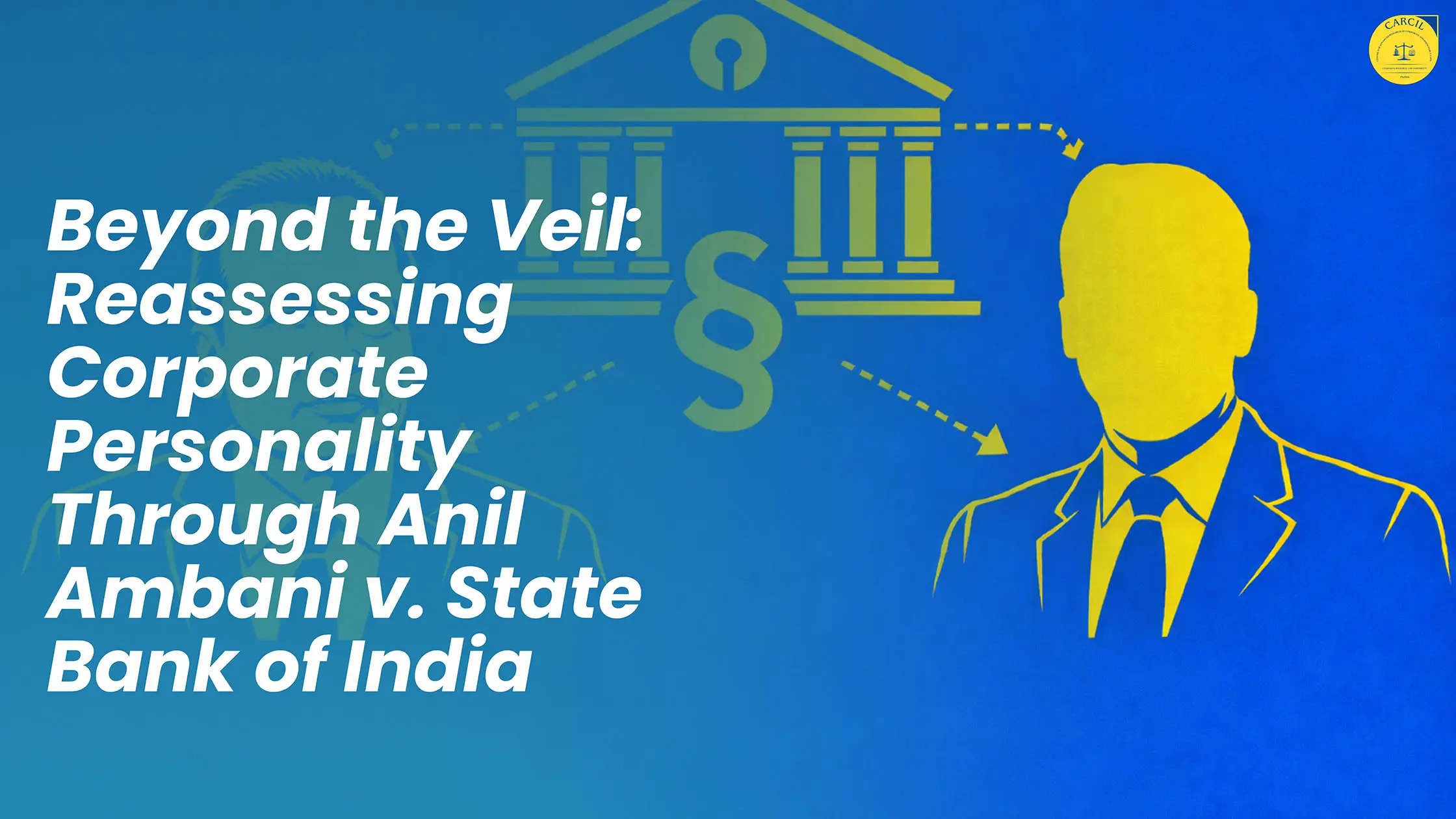
The decision made by the Bombay High Court in Anil Ambani v. State Bank of India (SBI) has brought back this debate. The Court affirmed that SBI had correctly ruled that Reliance Communications and its chairman at the time, Anil Ambani, were defraudulent borrowers. It reiterated that promotion cannot be held responsible in cases where the lenders have been misled using the corporate structures when the promoters have limited liability. The following paper aims at tracing the development of the doctrine, examining the rationale of the court and evaluating the current applicability of these doctrines in the context of the Companies Act, 2013. It also strives to depict the changing corporate governance situation in India.
Evolution of the Corporate Veil
The corporate veil doctrine originated in the case of Solomon, which held that once a company is incorporated, it attains a legal personality which is distinct from its members. Indian jurisprudence has also adopted this stance by incorporating several amendments and judicial pronouncements. In addition to this, the Indian courts have long recognised the exceptions where the concept of justice demands the lifting of the veil. In State of UP v. Renusagar Power Co., the court treated Renusagar and Hindalco as a single economic entity for taxation, placing its reliance on the need to prevent artificial separation.
Various provisions in the Companies Act, 2013, have codified provisions where the directors and officers may be held liable, specifically recognising the veil-lifting principles. Section 2(60) defines “officer in default” covering those persons who give consent or take part in misconduct. Section 339 provides for personal liability in case of fraudulent conduct of business during winding up, while Section 447 places punishment for fraud. Further, Rule 11 of the Companies (Accounts) Rules, 2014 mandates that a detailed disclosure of related-party transactions must be provided to curb the misuse of complex corporate webs. Thus, while the corporate veil remains a functional safety to hide behind, statutory developments have widened its scope in cases where the veil can be pierced. This is done particularly in the cases of fraud, public interest and misuse of limited liability.
The Anil Ambani v. State Bank of India Case
In Anil Ambani v. State Bank of India, the petitioner challenged the decision of SBI to declare Reliance Communications (RCom) and the petitioner as a fraudulent borrower under the Master Directions on Frauds, 2016 issued by the Reserve Bank of India. SBI accused RCom of misrepresenting and stealing money that was sanctioned to the company and breaking the covenant of the loan agreement. Ambani argued that the classification breached the natural justice and unjustly charged him with the misconduct of the corporation, even though the legal entity called RCom was independent.
The Division Bench of Justices Nitin Jamdar and M.M. Sathaye rejected the petition as their classification relied on an in-house forensic audit that revealed that there was substantial misrepresentation. The Court observed that in the role of a chairman and guarantor, Ambani could not dissociate himself with the actions of the corporate body in which the decision-making process was signed and monitored by him. The case decision was similar to the pattern used in Delhi Development Authority v. Skipper Construction Co., in which the Supreme Court determined that the veil can be lifted when the corporate form is employed to avoid the will of the people or commit fraud.
Notably, the logic of the High Court went beyond the technicality of the proceedings. It has not seen the doctrine of limited liability as a promoter shield, but as an obligation bound by disclosure and honesty in financial transactions. It is a demonstration of judicial restraint and accountability in the corporate realm, and the Court declining to intervene in the judgment of the bank and instead leaving regulatory autonomy to regulators.
Critical Analysis
In this connection, the Anil Ambani case can be interpreted as a case of de facto interpretation of Section 339, but in the context of banking regulation. The ruling is also in touch with Section 447 of the fraud and Section 36(c) of the RBI Act, 1934, which gives the bank the authority to take action against any fraudulent transaction.
This reading is in line with the English Court of Appeal case of Gilford Motor Co. v. Horne, when the English Court of Appeal lifted the veil to allow a director to avoid the non-compete covenant by the company. In a similar case of New Horizons Ltd. v. Union of India, the Supreme court of India also discussed the actual character of a consortium company to ascertain the control and responsibility. These precedents argue in favor of the fact that form should be subservient to substance where the corporate organization is only a facade.
Contemporary Relevance
The ruling is also made when financial regulators in India are under mounting pressure to deal with willful defaults and misconduct of promoters. Certain big business entities were put under the microscope in 2024 alone, in terms of the Insolvency and Bankruptcy Code (IBC) and the Prevention of Money Laundering Act (PMLA). The Anil Ambani case is a decision that conforms to the judicial logic to a wider policy discourse of the government to exercise responsive capitalism.
Conclusion
The principle of the corporate veil remains one of the pillars of corporate jurisdiction; however, its invincibility is not unconditional. The decision in Anil Ambani v. State Bank of India represents a jurisprudence change of protection of entities to accountability enforcement. By placing the unveiling of the veil in the context of the wider financial regulation, the Bombay High Court has indicated that corporate structures cannot be used to absolve the promoters of the consequences of their actions. To this end, the modern-day corporate veil cannot be understood as an invulnerable shield but instead seen as a transparent veil that only protects the business as long as integrity and governance prevail in it.

Thank you for sharing your feedback.
Our team will get back to you at the earliest